Private cellular (CBRS)
For the devices that must never drop: scanners, vehicles, cameras on a private network.
How do I plan private cellular coverage?
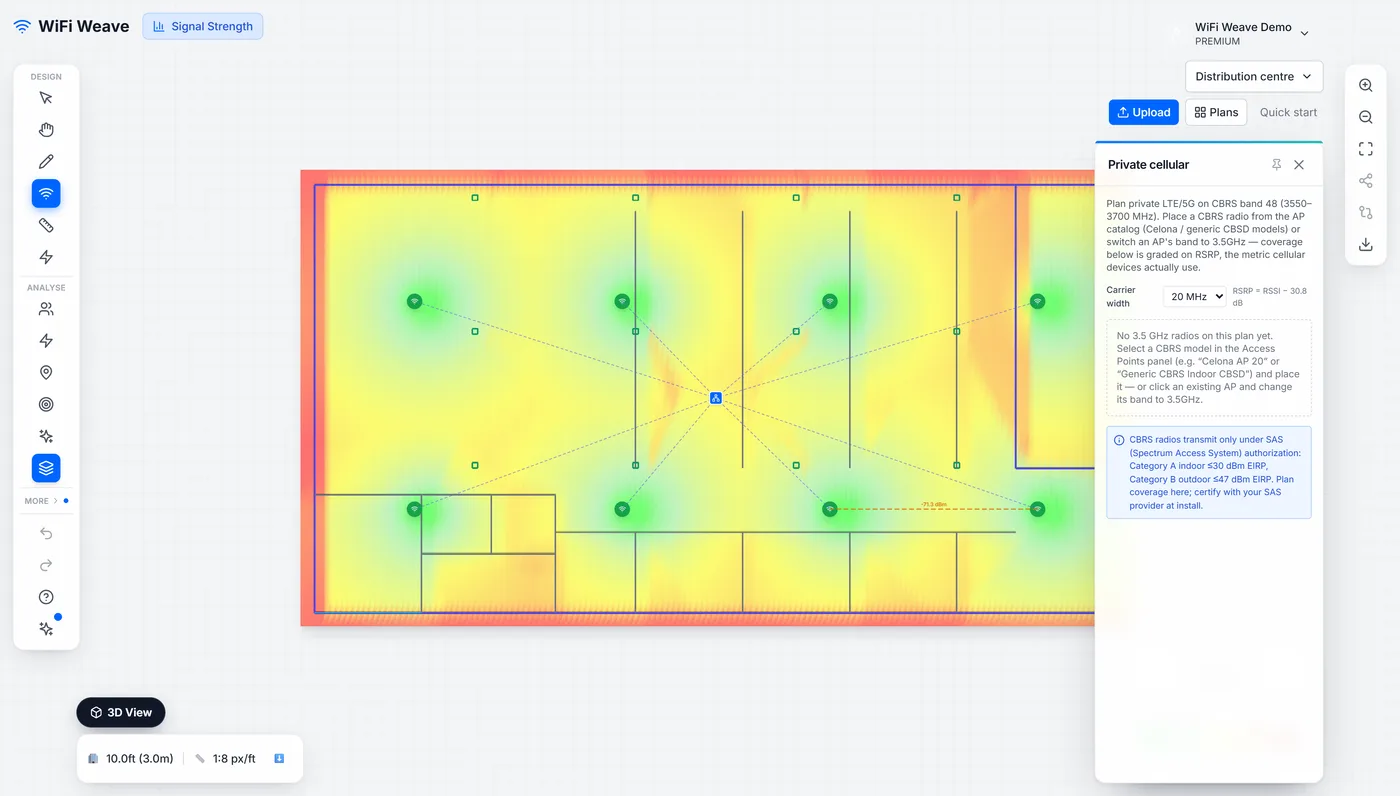
Place a CBRS radio the same way you place an access point — search the catalog for CBRS, pick a Celona or generic CBSD model, and click the plan. The private cellular panel then finds every 3.5 GHz radio and reports what each one covers.
Why is coverage graded on RSRP rather than signal strength?
Because RSRP is what phones and scanners actually report, so it is the number your vendor will quote back at you. RSRP is per-subcarrier power, which is why it sits well below the RSSI figure for the same radio.
| RSRP | Grade |
|---|---|
| −80 dBm or better | Excellent |
| −90 to −80 dBm | Good |
| −100 to −90 dBm | Usable |
Why does a wider carrier cover less?
Because the same transmit power is spread across twice as many subcarriers: doubling from 20 MHz to 40 MHz drops per-subcarrier power by about 3 dB and shrinks every radius. More capacity, less reach — a trade that is invisible if you plan cellular on a Wi-Fi heatmap.
What about spectrum authorisation?
CBRS radios only transmit under SAS (Spectrum Access System) authorisation, and power is capped by category: Category A indoor at 30 dBm EIRP, Category B outdoor at 47 dBm EIRP. Plan the coverage in WiFi Weave, then certify with your SAS provider at install.
Common questions
Can Wi-Fi and private cellular live on the same plan?
Yes — the same drawing, the same walls, both networks planned together.